
The Complete Home Fall Prevention Checklist for Seniors: A Room-by-Room Guide

Falls are one of the leading causes of injury among older adults, yet many can be prevented with simple home modifications and proactive planning. For home health clinicians, caregivers, and family members, understanding where fall risks exist is the first step toward helping seniors remain safe, independent, and confident at home.
According to the American Academy of Orthopaedic Surgeons (AAOS), most falls occur in and around the home, making home safety one of the most effective tools for injury prevention. That's why every home health professional should be familiar with common fall hazards and practical solutions.
Why Fall Prevention Matters
A fall can have life-changing consequences. Beyond fractures and physical injuries, falls can lead to a dangerous cascade of health declines, including...
Reduced mobility and physical deconditioning
Loss of independence and increased reliance on long-term care
Fear of future falls, which ironically increases fall risk by causing hesitation
Increased caregiver burden and emotional stress on families
Hospitalizations and readmissions, which disrupt recovery
For patients receiving home health services, preventing falls is often the single most important factor in maintaining their overall quality of life.
Who Is Most at Risk for Falls?
The AAOS Fall Awareness & Prevention Guide highlights several distinct factors that can increase an individual's fall risk. Home health clinicians should systematically assess all three categories during evaluations and follow-up visits to identify targeted opportunities for intervention.
📋 Risk Factor Breakdown
Medical Risk Factors | Personal Risk Factors | Environmental Risk Factors |
• Osteoporosis & Arthritis • Hip weakness & balance deficits • Stroke, Parkinson's, or MS • Vision or hearing impairments • Blood pressure fluctuations • Medication side effects | • Inadequate or loose footwear • Dehydration • Excessive alcohol use • Poor nutrition | • Poor lighting & dim hallways • Cluttered walkways & cords • Slippery surfaces & wet floors • Loose rugs & uneven thresholds • Pets creating tripping hazards |
Interactive Room-by-Room Safety Checklists
To make this guide actionable, we have broken down home modifications into interactive, location-specific checklists. Use these sections to audit a patient's living space.
🛁 Bathroom Fall Prevention Checklist
The bathroom is statistically the most hazardous room in the house due to wet, slippery surfaces and the physical demands of transferring.
Install secure grab bars inside the shower and next to the toilet.
Use non-slip mats or adhesive strips both inside and outside the bathtub/shower.
Utilize a shower chair or bench for patients with balance deficits or fatigue.
Add a raised toilet seat with armrests to make transfers safer and easier.
Keep a reliable nightlight plugged in to illuminate the path during midnight visits.
Replace fragile glass enclosures with shatterproof alternatives or lightweight curtains.
Clinician Tip: The bathroom provides valuable insight into a patient's true transfer ability, dynamic balance, and overall safety awareness. Always observe a simulated transfer.
🪜 Stairway Safety Checklist
Stairs present an extreme elevation hazard where a minor misstep can lead to catastrophic injury.
Install sturdy handrails on both sides of the staircase, extending the full length.
Keep all steps completely free of clutter, shoes, and books.
Ensure high-visibility lighting is controllable from both the top and bottom of the stairs.
Repair loose carpeting, wood planks, or molding immediately.
Add non-slip stair treads to wooden or uncarpeted steps.
Secure or remove throw rugs near the approach to the stairway.
Consider motion-activated lighting for hands-free illumination.
Clinician Tip: During home visits, physical therapists should directly observe how patients navigate stairs rather than relying solely on self-report, noting gait patterns and fatigue.
🍳 Kitchen Safety Tips for Seniors
Many kitchen falls occur during multi-tasking—such as reaching for heavy items, carrying hot liquids, or navigating slick tile floors.
Store frequently used items on lower shelves within easy, waist-high reach.
Clean up spills immediately to prevent slick spots on linoleum or tile.
Ban standing on chairs or boxes; utilize stable, locking step-stools with handrails if necessary.
Remove loose area rugs entirely from high-traffic cooking zones.
Use slip-resistant flooring or low-pile, rubber-backed mats at the sink.
Clinician Tip: Encourage patients and families to completely reorganize the kitchen so that daily essentials can be accessed without climbing, over-reaching, or excessive bending.
🛏️ Bedroom Safety Checklist
Nighttime disorientation, combined with urgency and darkness, makes the bedroom a frequent site for nocturnal falls.
Keep a dedicated lamp and telephone within arm's reach of the bed.
Install continuous nightlights along the exact path from the bedroom to the bathroom.
Clear all clutter, shoes, and clothing from the floors and walkways.
Ensure daily clothing is easy to reach without stretching or bending low.
Use secure bedding that does not hang down to the floor or slide off easily.
Optimize bed height so the patient's feet rest flat on the floor when sitting on the edge.
🛋️ Living Room and Hallway Safety
Many home hazards are hiding in plain sight within the main living spaces where seniors spend the majority of their day.
Create wide, clear walking pathways that accommodate assistive devices (walkers, canes).
Remove unnecessary furniture like low coffee tables or plant stands that obstruct paths.
Secure all loose rugs with heavy-duty double-sided tape, or remove them entirely.
Tuck electrical cords safely away from walkways and behind furniture.
Upgrade to higher-wattage, glare-free bulbs to improve lighting throughout the home.
Repair loose flooring or wrinkled carpeting immediately.
Remove or bevel elevated thresholds between rooms whenever possible.
🏡 Outdoor Fall Prevention Tips
Safety and independence shouldn't stop at the front door. Ensuring safe egress is crucial for community access.
Keep all walkways, porches, and driveways clear of leaves, ice, and debris.
Ensure adequate exterior lighting over porches, steps, and house numbers.
Install motion-sensor floodlights along walkways and garage entrances.
Maintain smooth, crack-free access from driveways to the mailbox.
Consider installing a ramp with handrails if steps become too difficult to manage safely.
Don't Forget About Footwear
The AAOS guide identifies improper footwear as one of the most frequently overlooked fall risk factors. A simple change in footwear can dramatically improve a senior's stability.
👉 Properly Fitting Shoes ➔ Rubber, Non-Skid Soles ➔ Low Heels ➔ Sturdy Slippers
❌ AVOID: Walking in socks on smooth wood/tile, loose slippers, or worn-out soles.
Emergency Protocol: What Should Patients Do If They Fall?
Even with the best prevention efforts, accidents can still happen. Educating patients on an emergency plan reduces panic and prevents secondary injuries (like lying on the floor for prolonged periods).
Stay calm and take deep breaths. Assess your body for pain or serious injury before moving.
Avoid rushing to stand up. Rolling or moving too quickly can cause a secondary fall or worsen an injury.
Crawl or slide toward a piece of sturdy furniture (like a heavy chair or couch) if you are physically able.
Use the furniture for leverage to slowly guide yourself up into a seated position.
Call for assistance immediately, or activate a medical alert device if you live alone.
📄 Download the Complete Fall Prevention Guide
Want comprehensive printed resources? Download the official Fall Awareness & Prevention Guide for a printable resource that clinicians, caregivers, and families can use to audit home safety and dramatically reduce fall risks.
Helping Patients Stay Safe at Home
At Lifespan Therapy, fall prevention is a core part of the comprehensive care we provide. Our multidisciplinary team of Physical Therapists, Occupational Therapists, Speech Therapists, and Medical Social Workers work collaboratively to help patients identify hazards, improve functional mobility, and remain independent in the place they want to be most—home.
If you're passionate about improving patient outcomes, reducing hospital readmissions, and making a meaningful impact through home health care, we want to meet you.
Join Lifespan Therapy
Be part of a team that's helping patients stay mobile, independent, and fall-free at home.
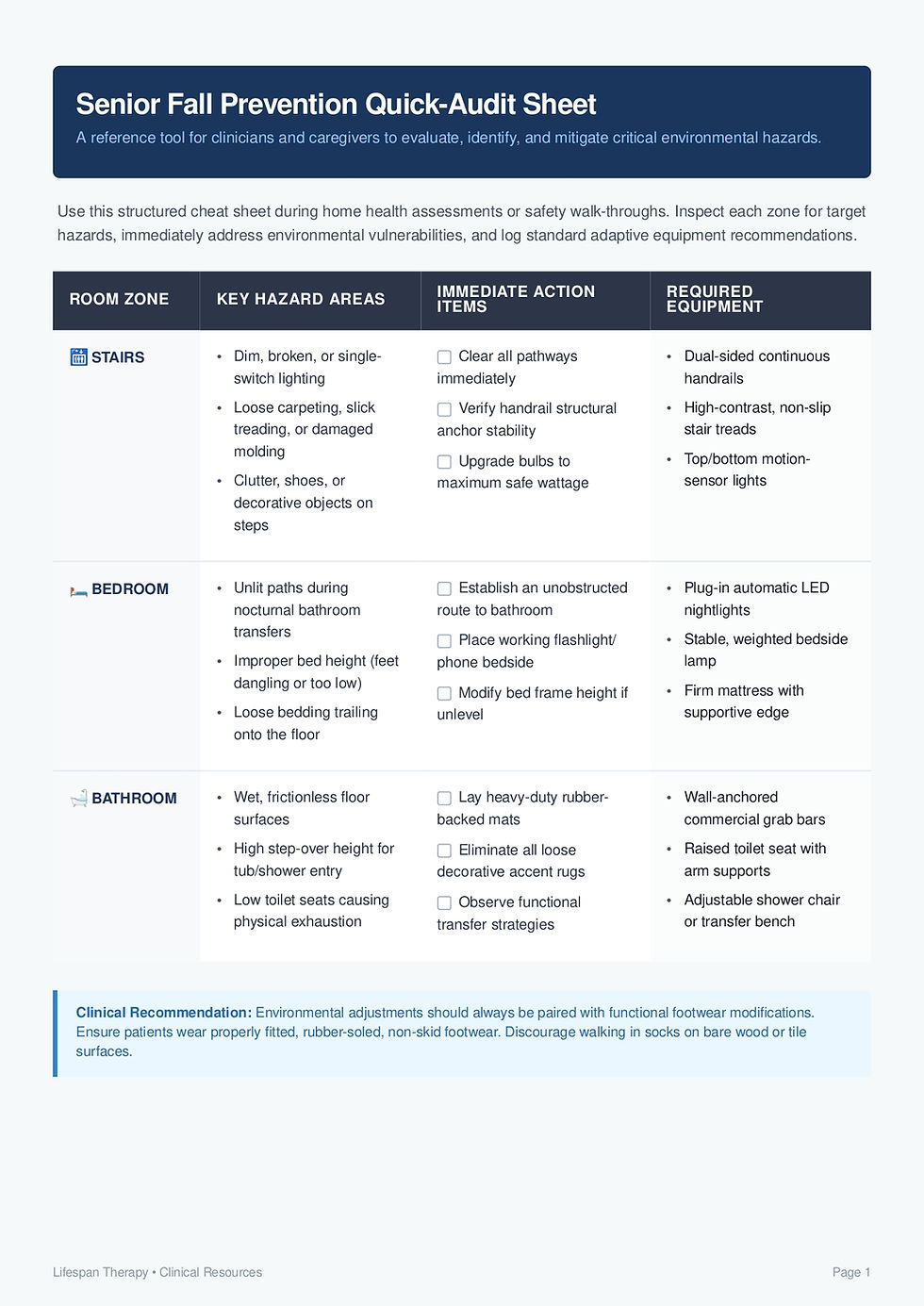
Quick Room Audit
Print or screenshot this quick-reference matrix for fast home health safety assessments.



Comments